Industry insights: Streamers are widening the price gap between tiers, Skydance has closed its $111 billion merger, and CTV now carries 53% of Europe’s premium video ad views.
Streaming services are raising ad-free prices while keeping ad-supported and bundled tiers cheaper, so that cost-conscious viewers downgrade instead of canceling. The shift matters because more viewers now cycle between services, signing up for a show, canceling, and moving on.
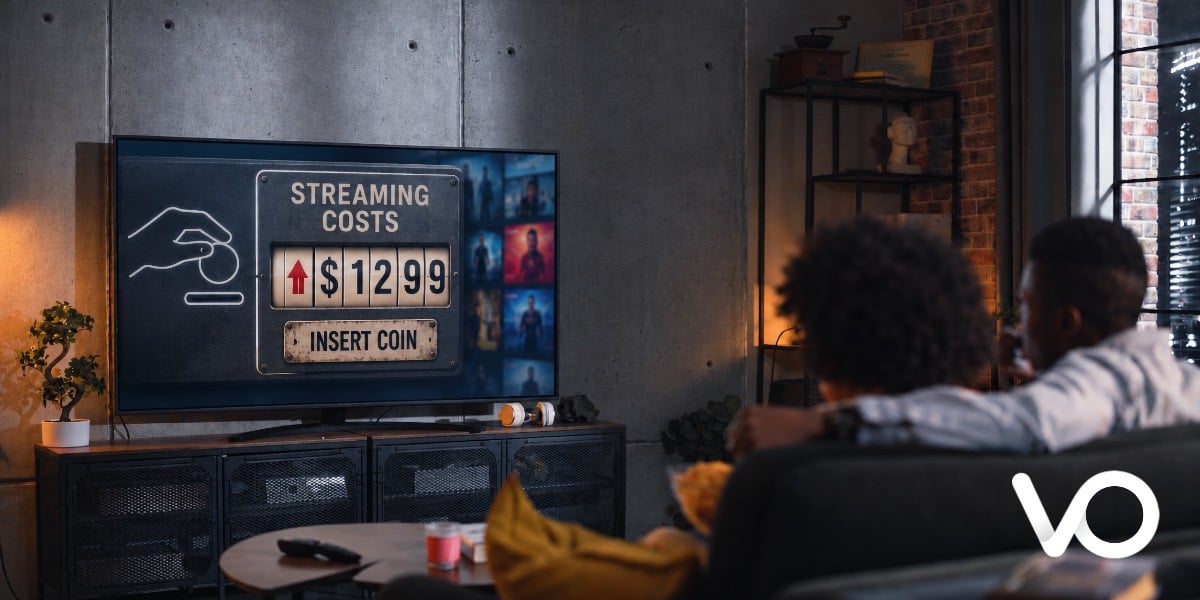 Streaming Price Increases Widen the Gap Between Tiers
[eMarketer, The Hollywood Reporter, Fortune]
One of the key trends of 2026 is that the price of the majority of streaming services has risen. Viewer subscriptions are still mainly driven by the availability of original content and exclusive rights, and providing that is an expensive business. As content budgets go up, the streamers are passing that cost on to the audiences.
Different companies have moved at different points in the year, and there is no guarantee that they won't do so again in the last quarter. But so far the industry has seen an average 14% price hike on the ad-free tiers across the major platforms.
The picture is more mixed for ad-supported content. Some have remained static; some have seen smaller price rises. These services tend to have lower churn rates than what are now almost universally referred to as the "premium" ad-free services, and with targeted advertising experiencing continued growth (see below), companies are happy to push viewers in that direction.
According to eMarketer, streamers are now widening the price gap between tiers as they follow a new playbook. They simultaneously raising ad-free prices to capture revenue from subscribers willing to pay, while keeping ad-supported and bundled plans cheaper so that cost-conscious viewers downgrade instead of canceling.
Reducing outright cancellations matters too because more viewers are treating subscriptions as disposable. Between 2023 and 2026, the proportion of US consumers engaging in “streaming cycling” rose from 50% to 59%. These viewers sign up for a service to watch its latest content, cancel, and then move on to another.
This behavior in turn is being driven by price increases. Since 2022, streaming prices have risen more than three times as much as inflation. The Hollywood Reporter points out that if you want all eight major streamers without ads or bundle commitments, the cost is about $151 a month compared with a fully loaded cable bundle at around $170. Four years ago, the comparable streaming lineup cost about $90.
Mitigating streaming cycling, which we have often argued comes down to providing a high-quality, personalized service, looks increasingly urgent with each round of price increases.
Skydance Completes Its $111 Billion Paramount and Warner Bros. Discovery Merger
 On October 6, the long-running saga of the $111 billion Paramount-Warner Bros. Discovery deal was finally concluded, with the two companies formally merging under the Skydance umbrella. Chairman and CEO David Ellison unveiled the new name in the first post on X from the new company's account.
"Paramount and Warner Bros. shaped over a century of culture," he wrote. "By combining them, we aren't rewriting history, we're equipping these iconic studios with a more powerful engine. Together, we are Skydance: a creative-first home for bold, quality storytelling.”
It has been a long and winding road to get to this point. Netflix first tried to acquire Warner Bros. Discovery’s studio and streaming business in December 2025, before Paramount Skydance swooped in with a more attractive counter-offer to shareholders. The deal faced significant legal hurdles around the world, with Variety reporting that regulators in 68 countries were involved at some point or other. Its final hurdle was satisfying 12 US state attorneys general, who agreed to drop their challenge in return for commitments on film output, production investment, and editorial independence at CNN and CBS.
This is one of the biggest mergers between studios in Hollywood history, well ahead of the $71.3 billion Disney paid for 21st Century Fox. It brings together some of the best-known brands in entertainment (Paramount, Warner Bros., DC, CBS, CNN, Nickelodeon, HBO Max, and Paramount+) and some of the most valuable IP in the world (Harry Potter, Game of Thrones, Star Trek, and much more).
It's also a high-stakes one. The merger will reshape the media and entertainment landscape, particularly in the US and in areas such as cinema distribution. To finance the acquisition, Skydance starts out with a mountain of debt in the region of $80 billion. Is the company now too big to fail? It would perhaps not take too many shocks to the system, such as the current dismal run of Warner Bros. box-office failures (The Bride, Supergirl, and now Digger), to test that theory.
CTV Reaches 53% of Premium Video Ad Views in Europe
Connected TV (CTV) now accounts for 53% of premium video ad views in Europe, according to FreeWheel’s latest Video Monetization Report. Meanwhile, total programmatic ad views across the region grew 44% year over year (YoY) in the first half of 2026.
Against a background of rising ad views in both Europe and the US, and with Europe up 20% YoY against 12% in the US, the CTV momentum is strong. Its share of ad views in Europe has doubled since 2023. Programmatic CTV ad views are up 9% YoY in Europe and 10% in the US. In France in particular, programmatic CTV ad views rose 46% YoY and now represent an impressive 47% of premium video delivery.
Interestingly, more than half of bid requests now contain enriched data, according to the report, with "Genre" the most-used video field, appearing in 57% of enriched requests. FreeWheel links the expansion of addressable inventory to improving data availability and transparency.
It is also worth pointing out that average completion rates across pre-, mid-, and post-roll formats exceeded 90% across the three most popular CTV sub-devices. This indicates that audiences are perhaps finding their sometimes divisive presence not as intrusive as once feared. And as the data from our first story shows, once lower costs are explicitly linked to the presence of ads, then viewers seem happy to accept both ads and ad loads that they would have resisted only a few years previously