
As cost pressure and platform complexity continue to reshape the streaming landscape, at NAB Show 2026 we will showcase how we’re helping our customers meet these challenges and more.
 After years of platform proliferation, feature arms races, and subscriber growth at any cost, the market has recalibrated around a more demanding set of criteria: profitability, operational efficiency, and sustainable unit economics.
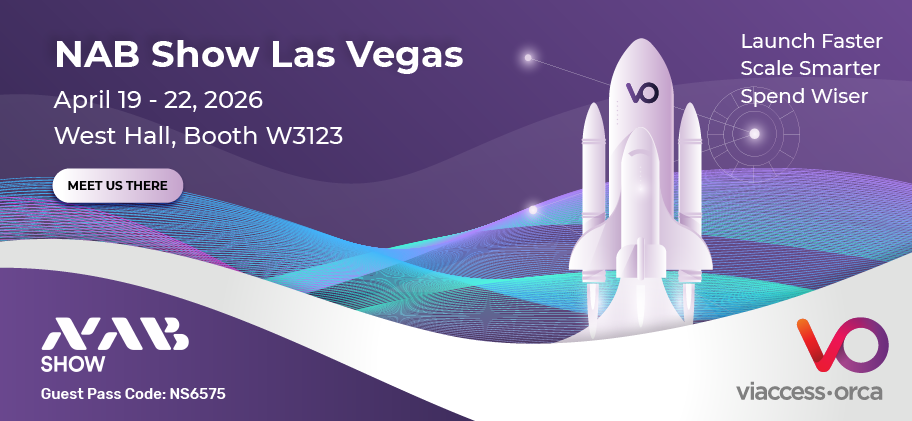
These are the challenges we prioritize at VO, and we will be showcasing our approach to meeting them on Booth W3123 from April 19-22 in Las Vegas, with a focus on what service providers are currently budgeting for.
"Service providers and operators are looking to reduce OpEx and CapEx by 10-20% over the next 2-3 years," says Stephan Nicolas, Chief Commercial Officer at Viaccess-Orca. "Efficiency, stability, and smarter monetization have become essential.”
The Case for Phased Modernization
Platform modernization remains a strategic imperative for most operators, but the appetite for large-scale, high-risk migrations has diminished considerably. The failures are well documented, the costs are hard to justify in a margin-constrained environment, and the disruption to live services is a risk most operators would rather not take.
VO's modular, cloud-native architecture is designed for exactly this environment. Rather than requiring operators to completely replace what they have, it allows modernization to happen incrementally: for example, OTT expansion here, a multi-DRM implementation there, better service visibility as a next step. It's an approach that aligns with how capital is actually being allocated right now, and it reduces the execution risk that has killed more than a few transformation programs.
Operational Efficiency at the Core
The more systems an operator runs, the more integration points there are to maintain, the more specialists they need, and the harder it becomes to move quickly when the market demands it. This is leading to the growing realization in the industry that platform complexity is a financial drain.
As operators manage more brands, more territories, and more service tiers, tools allowing for backend consolidation such as VO’s Multi-X feature have become increasingly valuable, as they allow for multi-brand and multi-region deployments within a single interface. Watermarking as a Service, meanwhile, moves content protection into a managed model, reducing the infrastructure burden on internal teams. And real-time QoE/QoS monitoring with early warning indicators shifts operations from reactive to proactive, helping head off subscriber churn tied to quality issues.
Narrowing the UX Gap
Subscriber expectations around user experience have been set by the major SVOD platforms, and the gap between what those platforms deliver and what most regional operators can offer is widening. The bottleneck is rarely ambition; rather, it's development capacity and the time required to push interface changes across a fragmented device landscape.
No-code UI customization tools like VO’s DaaS (Design as a Service) tackle that constraint directly. Driven by real-time usage data, operators can respond to what subscribers are actually doing rather than what product teams assumed they would do six months ago during a planning cycle. Combined with personalized recommendations and Quality of Experience Analytics, it starts to close the experience gap without requiring the engineering investment of building it from scratch.
Boosting Advertising Revenue
The AVOD and FAST markets have matured rapidly in recent years, but the monetization models that underpin them are still evolving. Dynamic ad insertion and audience segmentation are now baseline expectations; the differentiation is in how well those capabilities integrate with the viewing experience and the operator's broader data strategy.
The L-Band Ad Overlay format uses non-intrusive ad placements that generate revenue without interrupting playback, and is an approach that reflects industry-wide recognition that aggressive ad loads drive churn..
The Ecosystem Is a Competitive Advantage
One of the more significant shifts in how operators evaluate technology is the growing weight placed on ecosystem fit. A solution that performs well in isolation but creates integration friction with the existing stack is increasingly seen as a liability rather than an asset, particularly when internal engineering resources are under pressure.
VO's joint demonstrations planned at NAB with various industry partners are designed to address that concern directly via deep integrations that deliver solutions neither company could achieve independently. This allows operators to move faster and with lower risk than bespoke integration would require.
Meet with us in Vegas!
NAB Show has always been a great indicator for where the industry's investment priorities lie. This year is no different, and the priorities that will be at the top of any conversation on the show floor will be efficiency, resilience, and monetization that doesn't compromise the subscriber relationship. As the above all demonstrates, we are happy to say that our 2026 portfolio of solutions meets these challenges head-on.
We'd welcome the opportunity to discuss how these capabilities can apply to your business. There is plenty to talk about this year and many ways we can help you achieve your goals. To book a meeting with VO executives at booth W3123, visit viaccess-orca.com/nab-2026.