
The evolving streaming landscape in the Americas, including the trends in ad-supported models, piracy, and market consolidation North and South.
 It is an extremely interesting time for the streaming industry in the Americas, with a large degree of change underway in all major markets. The era of acquiring subscribers at any cost has given way to one defined by advertising innovation, platform consolidation, the quest for efficiency, and always the persistent, underlying challenge of content piracy.
For operators and service providers, the question is no longer whether streaming will dominate. It already does. In December 2025, it captured 47.5% of all US television viewing according to Nielsen, setting a new record.
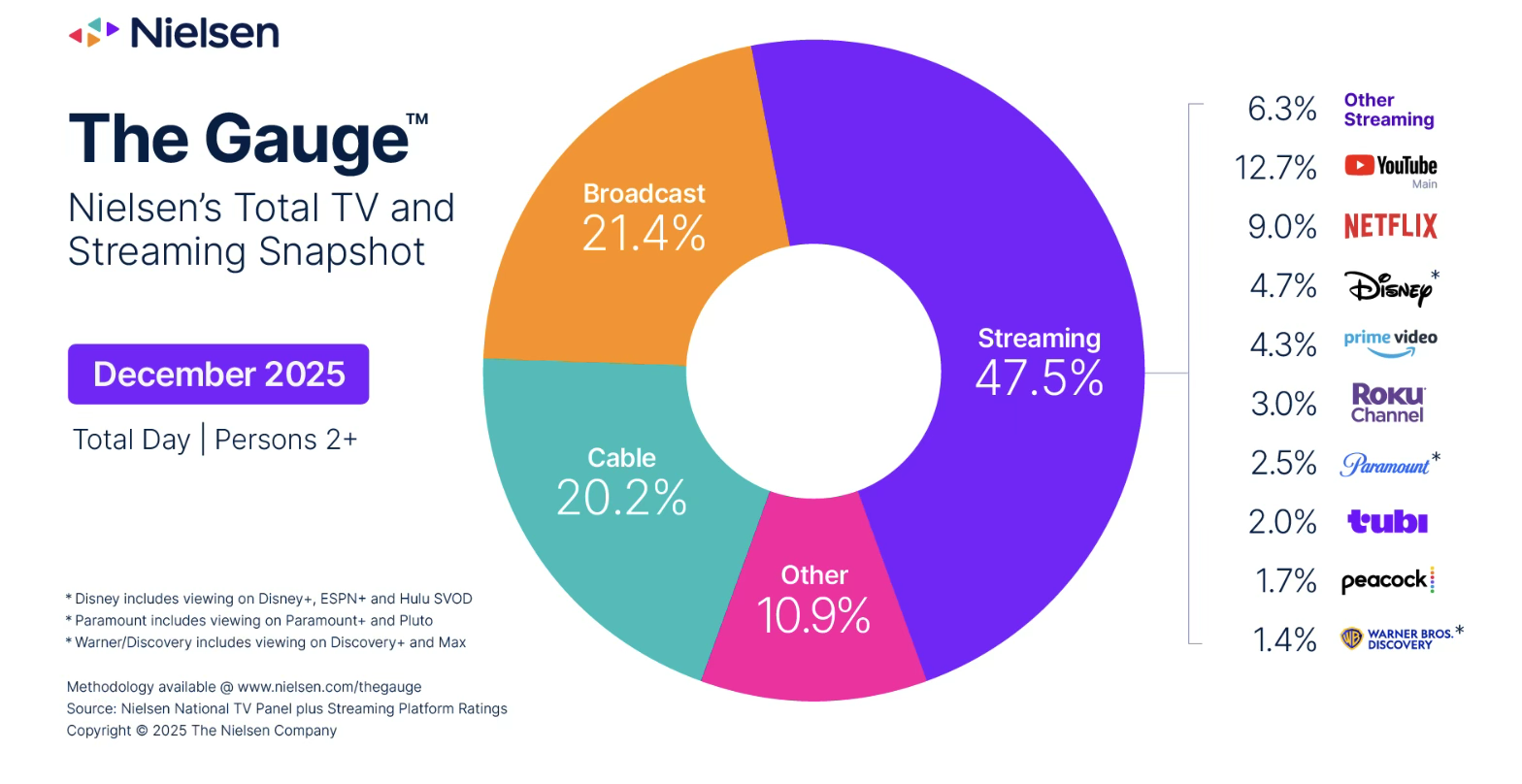
On Christmas Day alone, streaming accounted for 54% of all TV usage with 55.1 billion viewing minutes, boosted by back-to-back NFL games and a Stranger Things Season 5 episode drop on Netflix.
It is now projected that streaming will sustain over 50% of total viewing on a monthly basis by mid-2026. The question for all concerned is how to, protect, scale, and monetize what comes next.
The North American Picture
It is estimated that the global video streaming market will generate revenues of $212.83 billion in 2026. The importance of the North American market to the global industry is easy to quantify here too, as it accounts for nearly 42% of that figure alone. It may not be the fastest growing region when it comes to streaming revenue, that is currently APAC, but what happens in North America has a significant impact on the industry and the global streamers.
Two trends in particular have impacted the North American market in recent years. The first is cord-cutting. A recent study by MoffettNathanson says that traditional bundled pay TV has fallen to 43.2 million households, with nearly half of all bundled homes closing their accounts in just six years. That is a loss of 40.3 million homes.
Penetration of linear video delivered by all MVPDs (multichannel video programming distributors), traditional and virtual combined, has now dropped below half of all occupied US households for the first time. There are hopes that this is now approaching a floor consisting primarily of news and sports subscribers. But, even so, the fact that total pay TV penetration, including virtual services such as YouTube TV, is now at levels not seen since 1987 is a stark one
The second regional trend is the rise of FAST. Free ad-supported television now accounts for 5.7% of all US TV viewing, more than any individual broadcast network, and captures 15% of streaming time. Tubi leads the category with approximately 100 million monthly active users, while Pluto TV serves over 80 million. Consumer attitudes reinforce the trend: 68% of viewers in late 2025 said they would rather watch ads on a free service than pay more to avoid them.
If we widen that out to include ad-supported tiers of streaming services, the momentum is clear. The headline of an eMarketer article from last year put it well: Streaming growth [is] now driven by ad tiers, not ad-free plans. Ad-supported tiers now account for 46% of all premium SVOD subscriptions in the US, up from 33% in 2023, and were responsible for 71% of net subscriber additions over the past nine quarters.
If this carries on, the ad-free TV viewer will disappear entirely in a few years. Certainly, there is the growing sense that streamers see themselves as ad-first services nowadays, with subscriber packages still important but waning. They are aided in this by the growth of Connected TV. CTV ad spending is expected to grow to $46.89 billion by 2028, surpassing traditional TV advertising for the first time.
For platforms and operators at all tiers, this creates growing demand for ad insertion and content management infrastructure capable of operating at scale within ad-supported environments. Targeted TV Advertising looks set to accelerate its deployment across the North American landscape over the coming years as the industry shifts back to ad-supported models. The subscriber era was a powerful engine of growth, but the current return to advertising looks like it could be equally impactful.
The LATAM Picture
We start our look at LATAM with piracy. While the numbers are smaller, $8 billion annual losses against the US’s $29 billion (US Chamber of Commerce figures), the market trajectories are very different and it represents a far greater risk to growth in LATAM. An estimated 40 LATAM million households consume content from pirate online sources. The numbers vary significantly by local market.
Brazil and Mexico are the twin engines of LATAM growth. CTV penetration rates are striking, at over 90%. This is helping ensure that CTV ad spend in LATAM is projected to grow at double-digit rates through 2026. A massive 71% of current pay TV customers in the region have indicated a willingness to switch to ad-supported streaming models.
Brazil accounts for over 40% of streaming revenue in LATAM and is the third-largest FAST market globally by revenue ($152 million). But the region as a whole represents possibly the most significant growth opportunity in global streaming today. LATAM’s media revenues are forecast to reach $65 billion in 2026, growing at 10.7% year on year, nearly double the US growth rate. And with a population exceeding 600 million and VOD subscribers ‘only’ projected to reach 131 million by 2026, the headroom is only really dwarfed by the size of the opportunity.
Looking Ahead to the Rest of the Year
If there is a theme that unites North and South, it is that aggregation and consolidation are key factors when it comes to market growth.
In North America, this is customer facing. Major transactions such as the Paramount-Skydance and Warner Bros. Discovery deal and the integration of Hulu into Disney+ are reshaping the competitive landscape. As part of that, they are driving further moves towards aggregation and unlocking new demands for unified content delivery and monetization infrastructure.
In Latin America, the combination of rapid adoption, advertising-led growth, and acute piracy challenges has helped create a market where technology vendors capable of addressing the full spectrum are key players. Those that can address the full end-to-end business case and cover content protection from ad insertion to FAST channel management are best positioned to play a defining role in its development.
For both regions, the message is consistent. The advertising-supported model is now the industry's primary growth vector, and protecting this revenue requires not only sophisticated monetization tools, but equally sophisticated anti-piracy capabilities. The operators and platforms that get both right will help shape the next chapter of streaming across the Americas.