
VO Industry Insights: AI, IP, and creators in focus at NAB 2026, US platforms are consolidating their hold on European streaming, and content security alerts are rising sharply.
 Picture courtesy NAB Show
NAB 2026: what the show tells us about the industry
We had a great show at NAB 2026 with plenty of meaningful conversations throughout the course of its four days. We had time to look around too, and one of the things we noticed most was how the conversation around AI is changing.
It’s now less a case of asking what it can do in some vaguely defined future, but more what it can do here and now. Broadcasters and operators are looking for practical, real world implementations that can help ease their pain points, usually costs, with immediate effect.
In many ways we are moving onto the next wave of deployments. Recommendations, metadata extraction, localization, captioning, and formatting are now well-defined AI tasks where the technology is expected to be deployed. What will come next is the more sophisticated workflows that will be unlocked by the next generation of agentic technologies.
Elsewhere, the IP transition debate is essentially over. Cloud production works, and the question now is how to deploy it at scale and with resilience. Practically every major vendor framed their NAB presence around IP-native workflows, with a definite concentration on sport and live workflows. In fact, the movement of sports from what was once a peripheral track to one of the main supporting pillars of the NAB’s schedule has been striking, and highlights its importance when it comes to gaining and maintaining viewers for broadcasters and operators alike.
NAB no longer seems convinced that broadcasters and operators are its core audience, however. In its post-show press release it highlighted the growth in content creator attendance (up 140% over 2025) and it has expanded its Creator Lab dedicated floorspace to cover AI, business strategy, monetization, and audience development, essentially framing creators as fully-independent media businesses in their own right.
Overall registered attendance, meanwhile, was 58,000. Up on last year’s 55,000, but half what the show could expect in the mid-2010s. Global tensions undoubtedly played a part in keeping attendance figures below their potential this year, especially when talking to European visitors. It will be interesting to see whether an increasing creator attendance and a more stable geopolitical environment in 2027 can start to edge those numbers up towards six figures again.
US giants are winning the streaming wars in Europe
[The DPP]
A new research collaboration between the Digital Production Partnership (DPP) and Swedish analyst firm Mediavision has mapped how audiences across 11 European markets are consuming streaming services, social video, and linear TV.
The European TV & Streaming Outlook set out to answer questions that existing market data couldn't: how daily viewing time is actually split across linear, streaming, and social video; how far streaming has progressed as a daily-reach medium; and how the balance of power is shifting between local and international players.
The online transition is universal, but Europe is far from a single market. In Sweden, traditional TV has already fallen to around 30% of daily viewing share; in Italy, linear still accounts for more than half. Social video engagement ranges from 12% in Finland to 20% in Sweden and 19% in France.
It’s a complex picture, but the headline is that streaming is now a daily habit rather than an occasional complement to broadcast. Online video services reach 63-75% of the European population every day, though the amount of time spent viewing varies considerably by market.
YouTube and Netflix consistently occupy the top positions across most markets, with Amazon Prime Video, Disney+, HBO Max, and Apple TV+ trailing behind. Social platforms — Instagram, TikTok, and Facebook — each reach around 20% of the population daily. US-based companies dominate both the streaming and social layers of the European attention economy.
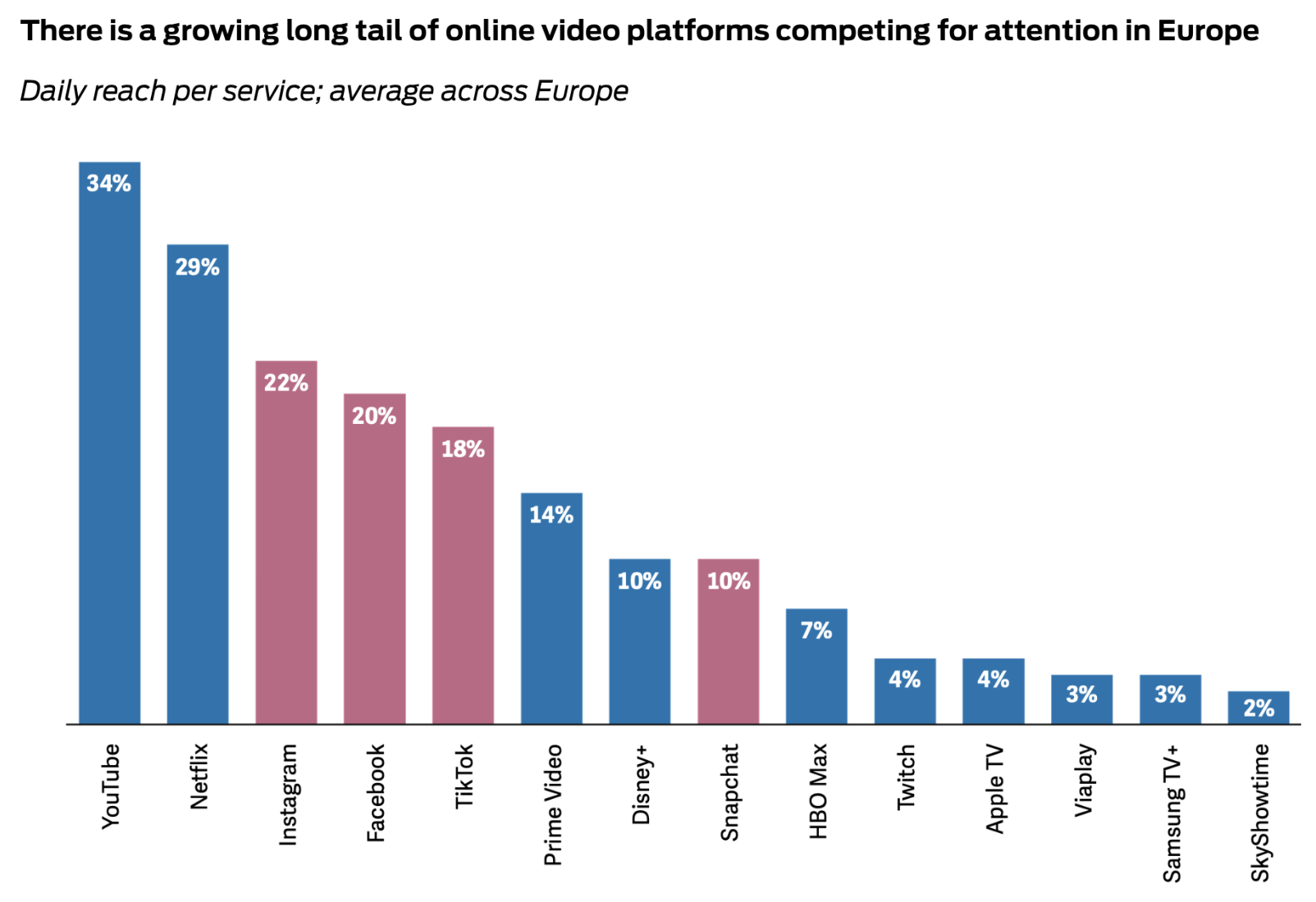
The local services picture is mixed but revealing. In Poland, Germany, France, Spain, Italy, and the UK, the leading local service ranks only fifth in its own market. In Finland, by contrast, the national broadcaster's Yle Areena ranks second overall, ahead of Netflix, and only behind YouTube. The Nordic cluster stands out as a region where local champions have carved out substantial positions, while southern and western Europe show weaker local performance and stronger US platform dominance.
One detail worth noting: as more content on both YouTube and Netflix originates outside the US, the dominance of American platforms doesn't necessarily translate into a dominance of American content.
In terms of stacking, approximately 80% of Europeans have at least one SVOD service, but the average number of subscriptions per household sits around three. The research suggests this represents a practical ceiling on subscription stacking and one substantially lower than the 4.5-5.2 average recorded in the US. The implication is that anyone planning to launch another paid streaming service faces a saturated market.
Why content security is inseparable from overall cybersecurity
 The Trusted Partner Network (TPN) has published its latest report analyzing how cyber risks are evolving across the global content supply chain. As a global, industry-wide content security initiative and community network for the film and television production supply chain, what the TPN says carries a lot of weight in the industry. The headline finding is an uncomfortable one: most organizations have security policies in place, but inconsistent day-to-day execution is creating systemic, exploitable risks.
We have written about cybersecurity and the problem of ransomware before, but the scale of the issue is underlined by the fact that in Q1 2026 alone, TPN issued more Security Alerts than in the whole of 2025. The dominant threats are credential-based attacks, misconfigurations, and unpatched vulnerabilities. The report's assessment data shows that the weakest-performing control areas are vulnerability management, cryptography, endpoint hardening, and access management. These are also the areas with the highest rates of non-compliance and the slowest remediation timelines.
TPN President Terri Davies identifies a persistent gap between perceived and actual security performance: organizations routinely overestimate how effective their controls are, particularly those requiring continuous technical attention. Meanwhile, more sophisticated capabilities such as Zero Trust architectures, conditional access, continuous authentication, and automated compliance monitoring remain far from standard across the entertainment industry.
The concern is amplified by the nature of modern production environments: distributed workforces, cloud platforms, and complex third-party vendor ecosystems mean a single compromised credential can have disproportionate impact.
The report calls for faster vulnerability remediation, continuous monitoring, stronger ownership of operational controls, and consistent enforcement of identity and access protections, particularly across third-party environments. As the Motion Picture Association’s Karyn Temple puts it, content security is now inseparable from overall cybersecurity, and protecting IP at scale demands the same operational discipline expected in other high-risk sectors such as banking and healthcare.